
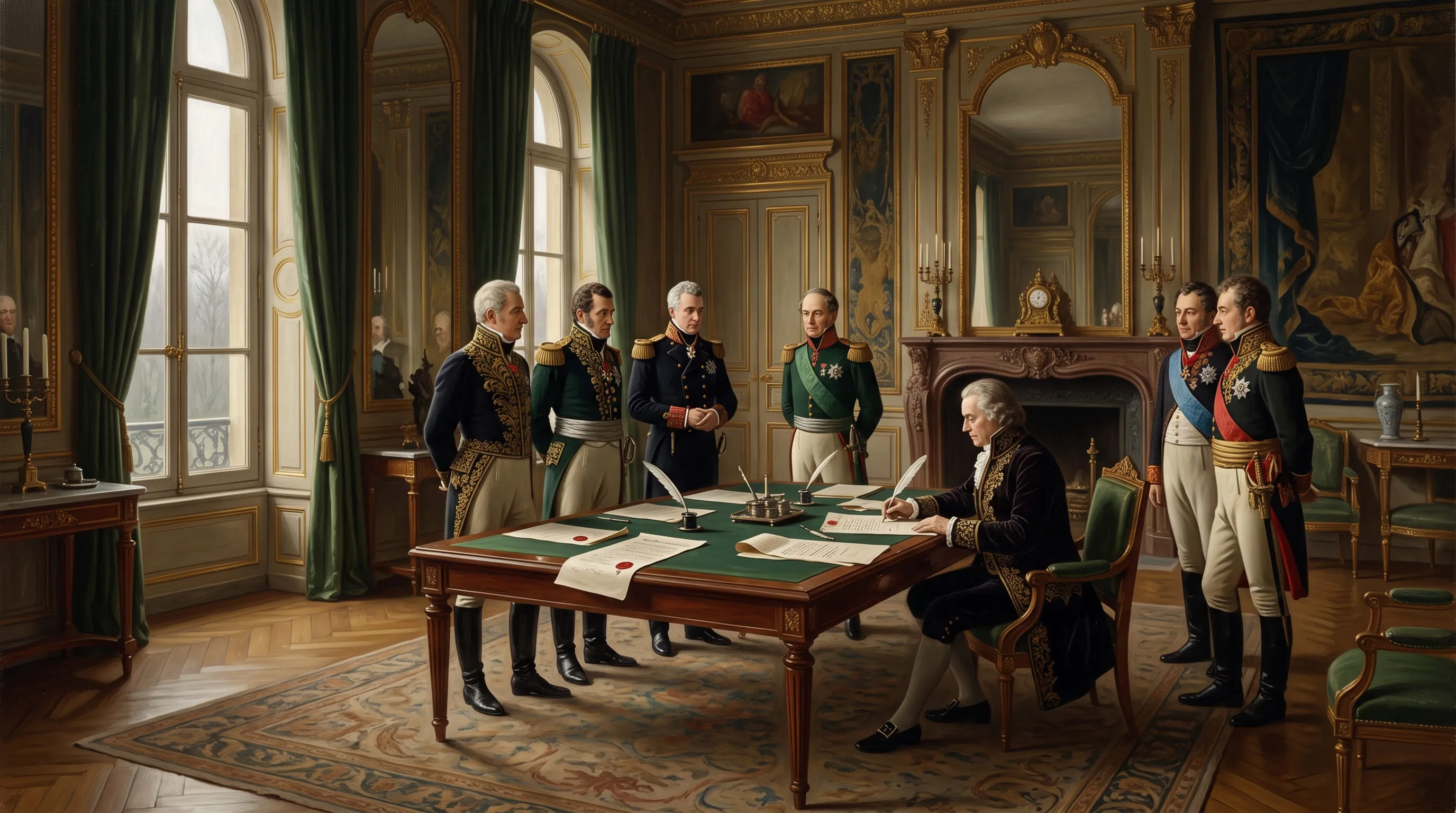
On May 30, 1814, in the French capital that Allied armies had occupied less than two months earlier, representatives of four great powers and a diplomatically resurrected France signed a document that ended one of the most destructive wars in European history. The Treaty of Paris of 1814 was, by the standards of most victorious coalitions, an extraordinarily generous settlement. France lost no territory it had held before the Revolutionary Wars. It paid no reparations. It kept cultural treasures its armies had looted from across the continent. And the man who signed on its behalf, a former bishop who had served the Revolution, the Directory, the Consulate, and the Empire in turn, managed to negotiate terms that left France with more than anyone had a right to expect after nearly a quarter century of war.
The story of how that happened, and what the treaty set in motion, is one of the defining episodes of early 19th century European diplomacy.
The Road to Abdication
By early 1814, the military situation that had once made Napoleon Bonaparte the master of Europe had reversed beyond recovery. The catastrophic Russian campaign of 1812 had destroyed the Grande Armée as an effective fighting force. The defeat at the Battle of Leipzig in October 1813, involving more than half a million soldiers over three days, had broken French dominance in Germany and opened the road to France itself. Allied armies were advancing from the east, the north, and the south.
The four great powers that formed the core of the Sixth Coalition, Great Britain, Austria, Prussia, and Russia, had formalized their unity in the Treaty of Chaumont on March 10, 1814, just weeks before Napoleon's final defeat. Under that treaty, they agreed to remain allied until a final victory over Napoleon was achieved and then to hold a general European congress to secure the peace. They also agreed on what that peace would look like: France would be reduced to its borders of January 1, 1792, which meant surrendering the vast territories the Revolutionary and Napoleonic armies had conquered across Europe, but retaining what France had actually been before the wars began.
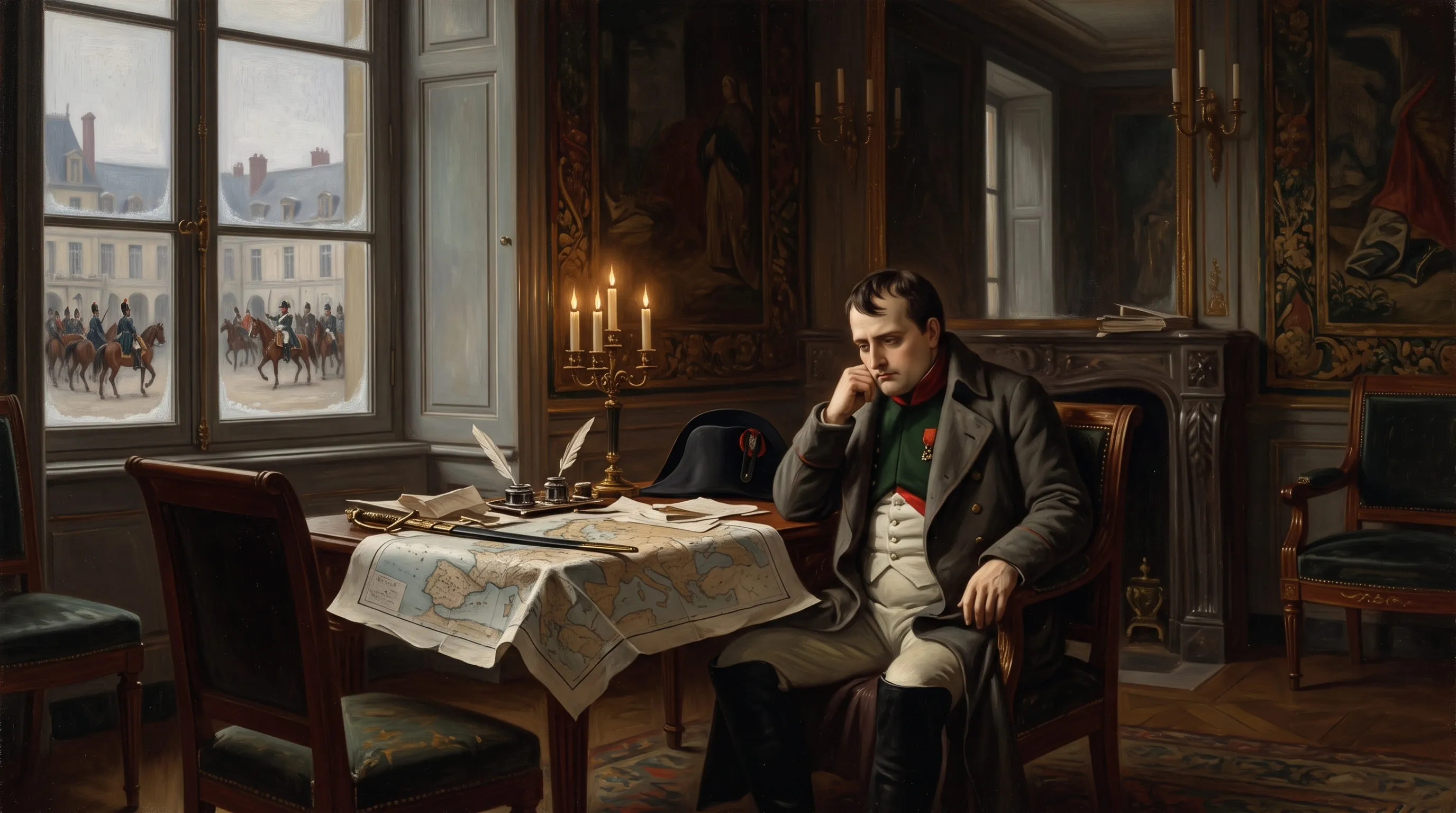
On March 31, 1814, Allied forces entered Paris. It was the first time in four centuries that a foreign army had occupied the French capital. Napoleon, maneuvering with military skill he could no longer translate into political survival, had refused to abdicate until he had no other option. On April 6, at the Palace of Fontainebleau, he signed a conditional abdication under the terms that would be formalized in a separate Treaty of Fontainebleau. He was granted sovereignty over the island of Elba, a modest pension, and an honor guard. His wife Marie-Louise and their son would not be joining him. An armistice followed on April 23, signed between Charles of Bourbon, Count of Artois, acting as Lieutenant General of the Realm for his brother, and the Allied powers.
Talleyrand and the Art of Negotiating from Weakness
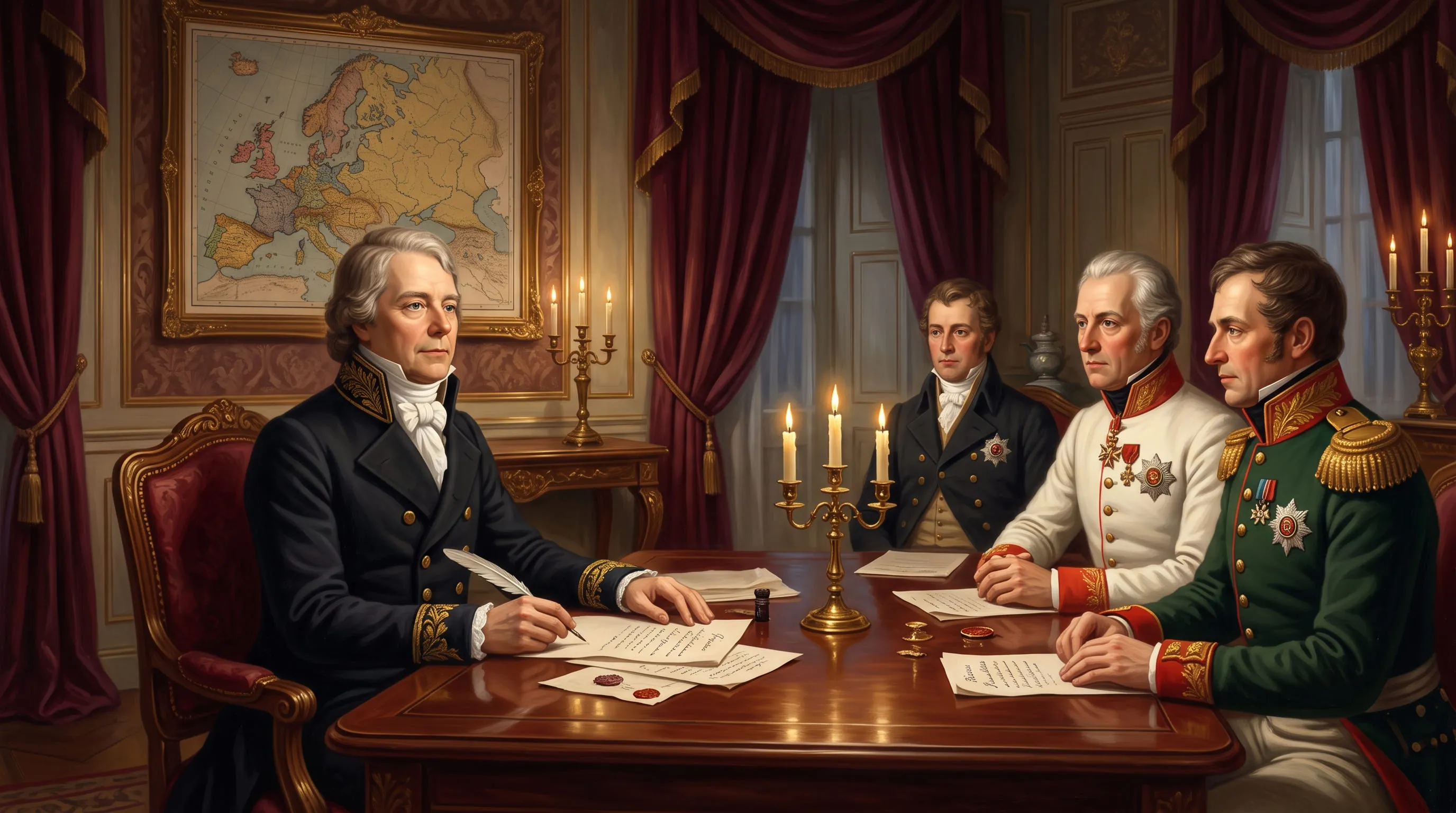
The French negotiator at Paris was Charles-Maurice de Talleyrand-Périgord, one of the most remarkable diplomatic operators in European history. His career was a study in survival through political agility. A nobleman who had served as a bishop before the Revolution, he had subsequently served the Revolutionary government, the Directory, Napoleon as foreign minister from 1797 to 1807, and now, after years of secret correspondence with Louis XVIII in exile, the restored Bourbon monarchy.
Talleyrand had begun his pivot away from Napoleon as early as 1807, when he resigned as foreign minister in opposition to the Emperor's continued wars. From that point he had conducted a careful double game, nominally within the imperial system while secretly advising Tsar Alexander I and the Austrian minister Metternich on how to handle a post-Napoleonic settlement. When Napoleon fell in April 1814, Talleyrand was positioned to take the lead, persuading Alexander I to accept the Bourbon restoration and the French Senate to formally depose Napoleon.
His strategic masterstroke was the argument of legitimacy: that the Allied powers should treat the restored Louis XVIII not as the representative of a defeated enemy, but as the legitimate monarch of a historic great power that had been hijacked by a revolutionary usurper. Under this framing, France had not lost the war. Napoleon had lost the war. France, restored to its proper constitutional order, deserved to be treated as a member of the European system of states rather than as a conquered territory. "France ceased to be gigantic in order to be great," as Talleyrand formulated it.
This argument carried because it served the interests of the Allied powers. A France stripped of territory and humiliated would be a France permanently resentful and potentially destabilizing. A France under a restored monarchy, integrated into the European order, would be a stabilizing force. The Allies had fought, at enormous cost, to contain French power, not to punish the French people. A manageable France was more useful than a martyred one.
The Terms: Generous in Spirit, Significant in Practice
The substantive terms of the treaty were negotiated between May 9 and May 30, 1814. The formal signatories on the Allied side were representatives of Great Britain, Russia, Austria, and Prussia. Portugal and Sweden also signed; Spain ratified separately in July.
The territorial settlement was the treaty's most consequential provision. France was confirmed in the borders it had held on January 1, 1792, a date that permitted it to retain not only its pre-Revolutionary territory but also the enclaves it had annexed in the early years of the Revolution, including Avignon and the Comtat Venaissin (seized from the papacy in 1791), the County of Montbéliard, part of Savoy including Annecy and Chambéry, and Saarbrücken and Saarlouis along the German border. The total area this permitted France to retain beyond its pre-1789 borders amounted to roughly 3,280 square miles.
What France surrendered was substantial: the left bank of the Rhine, Belgium, Holland, and all of Napoleon's conquests in Germany, Italy, and Switzerland. These were, however, territories France had conquered, not territories it had held before the Revolutionary Wars. The principle the Allies applied was not punishment but restoration: returning Europe as much as possible to the arrangement that had existed before the upheaval began.
The colonial settlement was less favorable to France. Most colonies lost during the war were returned, including Martinique and Guadeloupe in the Caribbean and French Guiana in South America. However, France permanently ceded Tobago and Saint Lucia in the West Indies, and the Île-de-France (now Mauritius) in the Indian Ocean to Great Britain. Malta, which Napoleon had seized in 1798, also remained in British hands.
Notably absent from the treaty were reparations. The Allies waived all financial claims against France, including debts Napoleon had accumulated through contracts and requisitions during his campaigns. There was also no comprehensive requirement to return cultural property. The treaty stipulated the return of archives and documents seized by French armies, but made no mention of the vast art collections Napoleon had systematically looted from Italy, Spain, the Netherlands, Egypt, and elsewhere. The Louvre, transformed into a museum by the Revolution and enriched by conquest under Napoleon, was permitted to keep its spoils.
The Political Framework: Restoring the Bourbons
The treaty was concluded in the name of Louis XVIII, who had been living in exile in England since the Revolution. His recognition as King of France by the Allied powers was one of the treaty's central outcomes, and it carried a strategic logic as explicit as the territorial provisions.
The Allies had determined that a restored monarchy offered the best prospect for long-term stability in France. A republic risked revolutionary spillover into neighboring states; Bonapartism risked renewed military expansion. The Bourbons, whatever their limitations, represented a dynastic legitimacy that could anchor a constitutional settlement and give France a recognized place among the crowned heads of Europe.
To make this work, the Bourbon restoration had to appear credible to the French public. This meant two things: that the peace terms had to be mild enough not to humiliate France into rejecting the new regime, and that Louis XVIII had to offer some form of constitutional framework rather than simply restoring the Ancien Régime. Both conditions were met, imperfectly. On June 4, 1814, Louis XVIII presented the Constitutional Charter to the French parliament, a document that established a constitutional monarchy with an elected legislature, guaranteed basic civil liberties, and preserved the legal and social reforms of the Revolutionary period.
The treaty was badly received by French public opinion anyway. Even the relatively moderate terms felt like a diminishment to a country that had dominated Europe for twenty years. Talleyrand, for all his diplomatic skill, had negotiated under conditions where France had almost no leverage. The treaty was accepted because the alternative, prolonged occupation and more punitive terms, was worse. But acceptance was not enthusiasm.
The Shape of the New Europe

Beyond France's borders, the treaty sketched the outlines of a European settlement that would be completed at the Congress of Vienna, mandated by Article 32 of the treaty itself. The congress, which met from September 1814 to June 1815, was the instrument through which the treaty's territorial provisions were translated into specific arrangements for every part of Europe.
Several major elements emerged directly from the treaty's framework. The Netherlands, freed from French dominance, had asked William I of the House of Orange to be their prince in late 1813. The treaty supported this, and the Eight Articles of London signed on June 21, 1814, formalized the great-power commitment to a strong buffer state on France's northern border. In March 1815, the United Kingdom of the Netherlands was formally constituted, incorporating the former Austrian Netherlands (Belgium) with the Dutch Republic under William I as king. This arrangement, creating a single strong state where Napoleon had held direct imperial control, was explicitly designed to prevent future French expansion northward.
In Germany, the many states Napoleon had consolidated were not restored to their pre-Napoleonic fragmentation. Napoleon's reorganization of German territory had served French strategic interests, but it had also rationalized a chaotic patchwork of hundreds of principalities, ecclesiastical territories, and free cities into a more coherent set of medium-sized states. These were retained, and Germany became, as the treaty specified, a federation of independent states, which was formalized as the German Confederation at Vienna.
Italy remained politically fragmented. Austria recovered influence over much of the peninsula, with its possessions bounded by the Po, the Tessino, and Lago Maggiore. The King of Sardinia recovered his ancient dominions and received the territory of Genoa as compensation for the portion of Savoy confirmed to France. The port of Genoa was designated a free port. The rest of Italy was composed of sovereign states whose final arrangements were left to Vienna.
Switzerland's independence was recognized, with a neutrality that would be codified more precisely at Vienna and in the Second Treaty of Paris of 1815. The freedom of navigation on the Rhine, an economically significant provision that opened the river to commerce from all riparian states, was established on principles parallel to those governing the Scheldt.
The Slave Trade Provision
One provision of the treaty stands apart from the territorial and diplomatic framework. France committed, under article pressure from Britain, to abolish the French slave trade within five years. This was the first international treaty commitment France had made on the subject.
The commitment was incomplete: it applied to future trafficking and carried a five-year delay. Slavery itself was not abolished in French colonies. And the provision did not apply immediately to French overseas territories. Nevertheless, it represented a significant diplomatic achievement by Britain, which had abolished its own slave trade in 1807 and was systematically pressing other powers to follow. The 1815 Treaty of Paris would strengthen this commitment, calling for abolition without delay and extending the obligation to all signatory powers. The practical enforcement of these commitments would take decades, but the principle had been placed in the public law of Europe.
The Road to Vienna and the Hundred Days
The Treaty of Paris of 1814 was explicitly provisional. Article 32 provided that the comprehensive European settlement would be concluded within two months at a general congress involving all belligerents of the Napoleonic Wars. The two months stretched to nine, but the Congress of Vienna, meeting from September 1814 to June 1815, eventually produced the Final Act that completed what Paris had begun.
At Vienna, Talleyrand operated with considerably more skill than the circumstances warranted. He exploited a major disagreement among the Allied powers over the future of Poland and Saxony, where Russian and Prussian ambitions collided with Austrian and British interests, to insert France as a balancing power and ultimately ally with Austria and Britain against the Russian-Prussian position. His manipulation transformed France from a defeated supplicant into a participant in the negotiations on something approaching equal terms with the victors.
Then, in February 1815, Napoleon escaped from Elba. He landed on the French coast on March 1 with 900 soldiers and marched north through France, gathering support as Louis XVIII's regime melted away before him. By March 20, he was back in Paris. The Hundred Days had begun.
The Allied powers responded with the formation of the Seventh Coalition. Napoleon's defeat at Waterloo on June 18, 1815, ended his restored reign, and a second abdication followed on June 22. Louis XVIII returned to Paris, and a second Treaty of Paris was signed on November 20, 1815.
The Second Peace: What Generosity's Absence Looks Like
The Second Treaty of Paris demonstrated by contrast what the first had achieved. The mood of 1815 was different: Napoleon's return had embarrassed the Allied powers, who had been too confident that the first settlement would hold, and the French public had welcomed him back enthusiastically enough to suggest that Louis XVIII's restoration was shallower than it appeared. The Allies were in no mood for generosity.
France was reduced from its 1792 borders to its 1790 borders, losing the Saar and much of Savoy. It was required to pay 700 million francs in reparations. It was made to pay for the maintenance of an Allied occupation army of 150,000 men in northeastern France for a maximum of five years. The cultural property exemption of 1814 was not repeated: the looted art collections were now demanded back, and the Louvre was systematically stripped of the masterworks Napoleon's armies had brought from Rome, Amsterdam, Madrid, and elsewhere.
France ultimately complied with the 1815 treaty's terms faithfully enough that the Allied occupation ended in 1818, two years early, and France was readmitted to the Concert of Europe as a full participant. This outcome, the re-integration of a defeated power rather than its permanent subordination, was precisely what the architects of 1814 had intended and what Castlereagh, the British Foreign Secretary, had argued for in 1815 against the more punitive instincts of his colleagues.
Legacy: The Architecture of European Peace
The Treaty of Paris of 1814, together with the Congress of Vienna that completed it, established the framework within which European diplomacy operated for the next century. The Concert of Europe, the system of great-power consultation and collective management of the balance of power, was the instrument through which the post-Napoleonic order was maintained. It was not a perfect instrument: it failed to prevent the Crimean War, failed to manage the unification of Germany and Italy, and ultimately collapsed in the catastrophe of 1914. But it lasted a century without a general European war, which was a considerably better record than what had preceded it.
The principle Talleyrand articulated in 1814, that legitimate states restored to their proper order deserve to be integrated into the European system rather than permanently subordinated, was the conceptual foundation of that achievement. It was also a lesson that would be largely forgotten and then painfully relearned after World War I, when the punitive terms of Versailles produced exactly the resentment and instability that the architects of 1814 had designed their settlement to avoid.
The first Treaty of Paris is rarely discussed in isolation from the Congress of Vienna, which completed its work, or from the Hundred Days and the second Treaty of Paris, which tested and revised it. But the decision made in May 1814, to offer France a peace without punishment, was the premise on which the subsequent century of European stability rested.
References
- Britannica. (n.d.). Treaties of Paris (1814-15). https://www.britannica.com/event/Treaties-of-Paris-1814-1815
- Britannica. (n.d.). Charles-Maurice de Talleyrand, prince de Bénévent. https://www.britannica.com/biography/Charles-Maurice-de-Talleyrand-prince-de-Benevent
- EBSCO Research Starters. (n.d.). Congress of Vienna. https://www.ebsco.com/research-starters/history/congress-vienna
- Encyclopedia.com. (n.d.). Charles Maurice de Talleyrand. https://www.encyclopedia.com/people/history/french-history-biographies/charles-maurice-de-talleyrand
- Encyclopedia.com. (n.d.). Paris, First and Second Treaties of. https://www.encyclopedia.com/history/encyclopedias-almanacs-transcripts-and-maps/paris-first-and-second-treaties
- FutureLearn / University of Southampton. (n.d.). The settlement of 1814. https://www.futurelearn.com/info/courses/wellington-and-waterloo/0/steps/24835
- GKToday. (n.d.). Treaty of Paris 1814. https://www.gktoday.in/treaty-of-paris-1814/
- Napoleon Series. (n.d.). Treaty of Paris 1814: Full text. https://www.napoleon-series.org/research/government/diplomatic/c_paris1.html