
The story of vernacular literature is usually told as a European story. Dante writes the Divine Comedy in Tuscan rather than Latin. Chaucer writes the Canterbury Tales in Middle English. Luther translates the Bible into German. The sacred languages of learned men give way to the spoken tongues of ordinary people, and literature becomes, for the first time, something that belongs to everyone.
That story is real, but it is incomplete. Across Asia, the Middle East, and Africa, similar transitions were occurring on their own timelines, driven by their own dynamics, producing works of comparable and sometimes greater ambition. Persian poets reclaimed their language from centuries of Arabic dominance. Indian saints composed hymns in regional vernaculars that Sanskrit could never have carried. Chinese novelists built entire fictional worlds in the spoken language that classical scholars disdained. In each case, the shift from prestige language to vernacular was not simply a democratization of literature but a statement about identity, power, and who gets to speak and be heard.
The Problem of the Prestige Language
Before turning to specific traditions, it helps to understand the structural dynamic that every vernacular literary movement eventually had to confront.
In any society with a literate class, there tends to emerge a prestige language: one that functions as the medium of scholarship, religion, law, and high culture, and that is typically distinct from the spoken language of ordinary people. The prestige language is learned, not acquired; it belongs to the educated minority, not the speaking majority. Its authority derives precisely from its difficulty, its distance from everyday speech, and its association with ancient texts and sacred traditions.
Latin played this role in medieval Europe. Arabic played it across the Islamic world after the 7th-century conquests. Sanskrit played it in the Indian subcontinent. Classical Chinese (wenyan) played it in East Asia. In each case, to write in the prestige language was to claim membership in an educated elite; to write in the vernacular was, initially, to be seen as writing for those who could not access the real thing.
The decision to write in the vernacular was therefore never just a stylistic choice. It was a claim about what language deserved to carry serious thought, about who the audience for literature was, and, often, about cultural identity in the face of political and religious pressure. The European vernacular movements understood this; so did their counterparts elsewhere in the world. The interesting question is not simply that these transitions happened but how and why.
Persian: A Language Reclaimed
The most dramatic vernacular recovery story outside Europe is the revival of Persian as a literary language after the Arab conquest of Iran.
When Arab armies swept through the Sasanian Empire in the 630s and 640s CE, they did not simply impose a new political order. Arabic became the language of the Quran, of Islamic law, of scholarship, and of administration throughout the conquered territories. For the Persian-speaking world, this meant that the native language was displaced from virtually every domain of formal culture. Pahlavi, the Middle Persian of the Sasanians, fell into disuse as a written language. For roughly two centuries, a Persian intellectual who wanted to participate in the world's leading discourse of philosophy, theology, or literature had to do so in Arabic. Many did: some of the most important figures of early Islamic civilization, including the physician Avicenna (Ibn Sina) and the mathematician al-Khwarizmi, were Persian by origin but wrote primarily in Arabic.
The recovery of Persian as a literary language began gradually in the 9th and 10th centuries, under the patronage of the Samanid dynasty in Transoxiana (modern Uzbekistan and Tajikistan) and the Buyid dynasty in Iran. Persian poets and writers began composing again in their own language, now written in the Arabic script rather than the Pahlavi alphabet, incorporating vocabulary from Arabic but building on the phonology, grammar, and literary traditions of their own tongue. This was New Persian: a language simultaneously continuous with its pre-Islamic ancestor and transformed by centuries of contact with Arabic.
The culminating monument of this revival is the Shahnameh of Ferdowsi, completed around 1010 CE after more than three decades of composition. The Shahnameh, meaning the Book of Kings, is the longest poem composed by a single author in world literature: nearly 50,000 couplets chronicling the kings and heroes of Iran from creation to the Arab conquest of the 7th century. Ferdowsi composed it in New Persian, and he did so with explicit cultural purpose: to preserve the memory of pre-Islamic Iran in a form that Persian-speaking audiences could read, recite, and pass on.
The Shahnameh's place in Persian cultural history is sometimes compared to that of Shakespeare in English or Goethe in German, but those comparisons undersell its significance. When a leading Egyptian historian was asked why the heirs to ancient Egyptian civilization speak Arabic rather than Coptic today, the reply was simple: "Because we had no Ferdowsi." Of all the peoples conquered by the Arab armies in the 7th century, the Persians are the only ones who maintained a major literature in the language they spoke before the conquest. The Shahnameh is a central reason why.
It would be reductive, however, to read the Shahnameh purely as a work of anti-Arab cultural resistance. The text is complex: it acknowledges the role of fate and divine will in the Arab conquest, incorporates Islamic themes alongside pre-Islamic material, and reflects the syncretic cultural environment of the Samanid and Ghaznavid courts where Persian and Arabic learning coexisted and enriched each other. Ferdowsi's genius was not to reject the Arabic cultural world but to demonstrate that the Persian language was capable of carrying literature of comparable grandeur.
The Persian literary tradition that the Shahnameh anchored went on to produce Rumi, Omar Khayyam, Hafez, and Saadi, among others, and Persian became a prestige literary language in its own right across Central Asia, the Ottoman Empire, and Mughal India. The language that had been displaced by Arabic became, through its vernacular literary revival, one of the great literary vehicles of the Islamic world.
Indian Vernaculars: Sanskrit, Bhakti, and the Languages of Devotion
Sanskrit occupies a position in Indian civilization broadly analogous to Latin's in European civilization: a classical language of learning, religion, and high culture that was functionally distinct from the spoken languages of the population but that served as the standard for serious writing across a vast geographical area and many centuries.
Tamil stands as a significant exception to this pattern. Among the major languages of the Indian subcontinent, Tamil has the longest literary history as a written vernacular, stretching back to works like the Tolkappiyam (a grammar and poetics treatise whose oldest portions date to perhaps 300 BCE or earlier) and the Sangam anthologies of classical poetry, composed roughly between the 3rd century BCE and the 3rd century CE. The Tirukkural of Thiruvalluvar, a work of extraordinary concision on ethics, governance, and love in 1,330 couplets of Tamil verse, is typically dated somewhere between 500 BCE and 500 CE. Tamil literary culture developed largely independently of Sanskrit, drawing on Dravidian linguistic roots that are structurally distinct from the Indo-European family to which Sanskrit belongs.
But the major wave of Indian vernacular literary production came from the Bhakti movement, a devotional religious tradition that arose in South India around the 6th to 8th centuries and spread northward over the following centuries. Bhakti (meaning devotion) theology emphasized direct personal relationship between the devotee and the divine, bypassing the ritual intermediaries and Sanskrit learning that formal Brahmanical religion required. This egalitarian spiritual emphasis had a natural affinity with vernacular expression: the point was to reach ordinary people, and ordinary people spoke Tamil, Kannada, Telugu, Marathi, Hindi, Bengali, and the dozens of other regional languages of the subcontinent, not Sanskrit.
The Bhakti poet-saints composed in these regional languages with deliberate purpose. Basavanna in the 12th century wrote his vachanas (prose-poems) in Kannada. The Alvars and Nayanmars of South India composed in Tamil. Mirabai, the 16th-century Rajput princess and devotee of Krishna, composed bhajans in Brajbhasha (an early form of Hindi). Kabir, a weaver of the 15th century whose social origins and religious identity remain matters of debate, composed in a mixture of Hindi dialects that cut across caste and religious boundaries with deliberate democratic intent. Tukaram in the 17th century composed abhanga poems in Marathi that became foundational texts of Marathi literary and religious culture.
The most widely known vernacular reworking of a Sanskrit classic is Tulsidas's Ramcharitmanas, composed in 1574 CE in Awadhi, a dialect of Hindi spoken by commoners in the Ganges plain. Tulsidas's version of the Ramayana, one of Hinduism's two great epics, was composed specifically to make the story accessible to people who could not read Sanskrit. Written in seven sections (kandas) totaling approximately 12,800 verses, it became one of the most widely memorized and recited religious texts in North India. Where the Sanskrit Ramayana of Valmiki was a prestige text for the learned, Tulsidas's Awadhi version was, and remains, something closer to a living scripture for millions of ordinary Hindus.
The paradox of the Bhakti movements is that texts born of the impulse to democratize religion eventually generated their own literary canons and prestige traditions. But the initial impulse toward vernacular expression permanently established the regional languages of India as vehicles for serious literary, philosophical, and religious thought, not merely as colloquial alternatives to the real thing.
Classical Chinese and the Long Resistance of Wenyan
The situation in China was structurally different from that in Persia or India. Classical Chinese (wenyan) was not a foreign language imposed by conquest, as Arabic had been in Persia. It was the native literary language of the Chinese tradition, but a literary language that had become progressively more distant from actual speech as spoken Chinese evolved while wenyan remained frozen in the forms of ancient texts.
Chinese writing is logographic: characters represent words or morphemes rather than sounds, which means that the same written text can be read by speakers of mutually unintelligible spoken varieties. This feature of the writing system made wenyan a powerful vehicle for cultural unity across the vast Chinese-speaking world, but it also meant that learning to read and write required mastering not just the characters but an entire grammatical and stylistic system that had no relationship to spoken language. The scholar who could write polished wenyan and the farmer who could barely read his own name were separated not by dialect but by an entirely different relationship to the written word.
Vernacular elements appeared in Chinese writing as early as the Tang dynasty (618-907 CE), particularly in Buddhist popular narratives (bianwen) found at the Dunhuang caves in northwest China. These texts, written in a language much closer to spoken Chinese than standard wenyan, were produced for popular religious education and entertainment, not for scholarly circulation. They hint at a potential vernacular tradition that did not immediately develop.
The major breakthrough came in the Yuan dynasty (1271-1368 CE), when the Mongol rulers' court culture created an unusual environment for vernacular Chinese drama (zaju). Yuan drama was written in a language much closer to the spoken northern Mandarin of the capital region, with dialogue that reflected real conversational patterns. The playwright Guan Hanqing (c. 1220-1300 CE) was among the most important figures of this tradition, and his plays circulated widely in performance, reaching audiences that wenyan texts could not have reached.
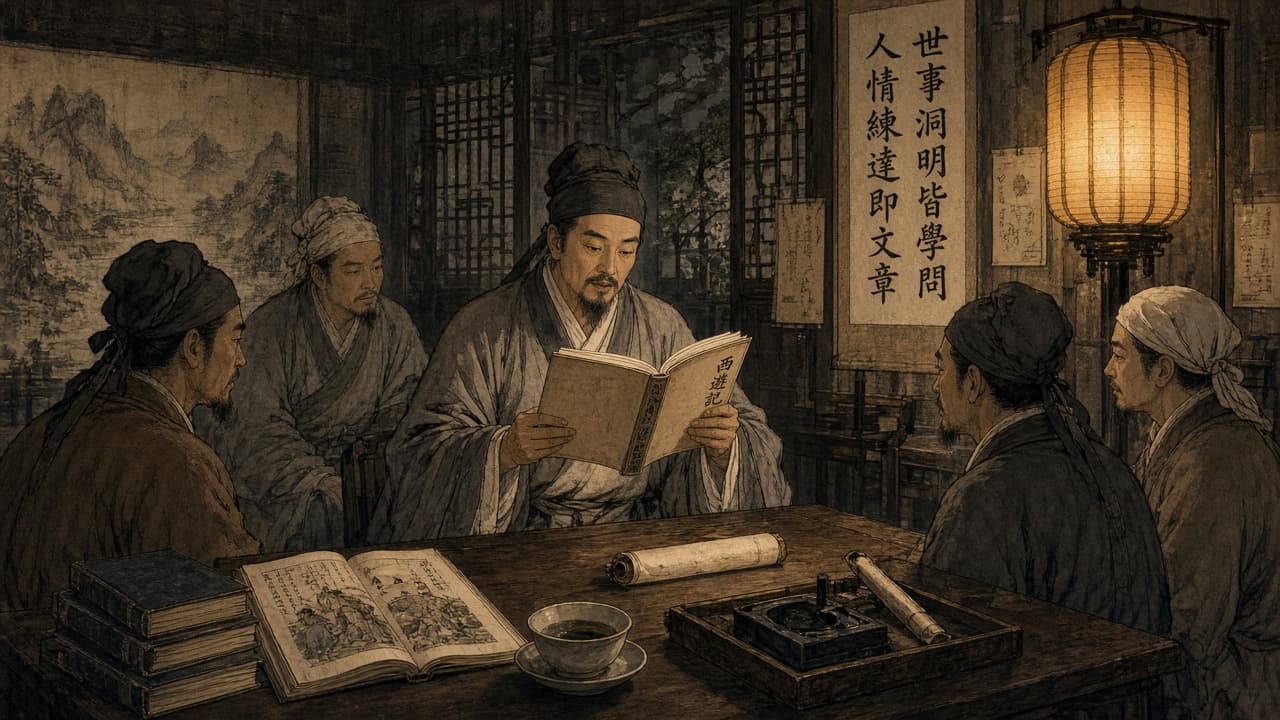
The Ming dynasty (1368-1644 CE) was the great period of Chinese vernacular fiction. The Four Great Classical Novels of Chinese literature were all composed during or consolidated in the Ming period. Water Margin (Shuihu Zhuan), attributed to Shi Nai'an and others, told the story of outlaws and bandits on the margins of legitimate society in language that drew on vernacular speech patterns. Romance of the Three Kingdoms (Sanguo Yanyi) dramatized the political and military conflicts of the 3rd century CE in a mixed style that included vernacular elements alongside classical ones. Journey to the West (Xiyou Ji), attributed to Wu Cheng'en, sent the monk Xuanzang on a fantastical westward journey with a cast of supernatural companions including the Monkey King Sun Wukong, whose irreverence and cunning spoke to popular sensibilities that classical literature rarely addressed. Dream of the Red Chamber (Honglou Meng), composed in the 18th century by Cao Xueqin, brought vernacular prose fiction to its greatest artistic heights in a densely realized social world of aristocratic decline.
The scholar-official class that dominated Chinese cultural life regarded these novels with ambivalence or contempt. Wenyan remained the medium of official communication, scholarship, and serious literary production. Vernacular fiction was entertainment for the masses, not literature for the educated. This attitude persisted into the early 20th century, when the reckoning finally came.
The New Culture Movement of 1917 to 1923 was the decisive rupture. Intellectuals including Hu Shi and Chen Duxiu argued for a wholesale reform of Chinese literary language, replacing wenyan with baihua (plain speech) as the medium of all writing. Hu Shi's famous formulation captured the spirit of the movement: "A dead language can never produce a living literature." Lu Xun (1881-1936), whose short stories in the new vernacular style included the enormously influential "A Madman's Diary" and "The True Story of Ah Q," became the movement's most celebrated literary practitioner. His prose combined the accessibility of spoken language with devastating social criticism, demonstrating that baihua could do what its classical advocates claimed only wenyan could.
The 1920s saw baihua become the medium of the Chinese literary press, educational system, and eventually official communication. The transition was more compressed than in Europe, where vernacular literature developed over centuries, and it was driven as much by anticolonial modernizing urgency as by literary preference. But the result was comparable: a written language aligned with spoken reality and accessible to a vastly larger audience than the classical tradition had ever reached.
Arabic and the Question of Diglossia
The Arabic case is distinctive and remains unresolved in ways that make the other vernacular transitions look straightforward.
Arabic occupies a unique position among world languages because of the Quran: the foundational text of Islam, regarded by Muslims as the direct word of God, is in Classical Arabic, and this has given Classical Arabic a sacred authority that no other prestige language has maintained in quite the same way. Across the Arabic-speaking world, a form of Modern Standard Arabic (fusha) derived from the classical tradition serves as the language of formal writing, education, broadcasting, and official communication, while every Arabic-speaking country has its own colloquial dialect (ammiyya) that differs substantially from fusha and from the dialects of other regions.
This diglossia, the coexistence of a formal high variety and an informal spoken variety, means that the Arabic vernacular question never got resolved the way it did in China or Europe. Egyptian colloquial Arabic, Moroccan Darija, Gulf Arabic, and Levantine Arabic are mutually intelligible only with difficulty and are all substantially different from the Modern Standard Arabic that educated Arabs write and read but typically do not speak natively.
The 19th and 20th centuries saw repeated debates about whether literature should be written in fusha or in colloquial dialects. Egyptian writers experimented with dialect in fiction, and Egyptian popular culture, including film and television, has effectively made the Egyptian dialect a pan-Arab vernacular understood across the region. Some Lebanese and Egyptian poets composed in colloquial Arabic from the early 20th century onward. But fusha has never been displaced as the primary literary medium in the way that Latin was displaced in Europe or wenyan in China. The sacred status of Classical Arabic, combined with the political value of a shared written standard across 22 countries, has kept the prestige language alive and functional in a way that no equivalent force preserved Latin or wenyan in their respective traditions.
The Pattern Across Traditions
Set alongside each other, these vernacular transitions reveal a consistent underlying pattern with significant local variation.
Each tradition had a prestige language that was learned rather than acquired and that served as the medium of scholarship and high culture. Each had a vernacular spoken reality that the prestige language increasingly failed to represent. And in each case, the moment of vernacular literary emergence was also a moment of cultural, religious, or political assertion: Persian identity against Arab cultural dominance; Bhakti devotionalism against Brahmanical exclusivity; popular Chinese fiction against the gatekeeping of the literati; baihua modernism against a Confucian tradition seen as complicit in China's weakness.
The European story of vernacular literature is usually told in terms of democratization: the people getting access to culture previously reserved for the learned. That story is true outside Europe too, but it is only part of the picture. What the Persian, Indian, Chinese, and Arabic vernacular traditions also show is that language choice is never politically neutral. To write in Awadhi rather than Sanskrit, in New Persian rather than Arabic, in baihua rather than wenyan, was to make a claim about which community's experience deserved to be expressed in writing, about whose world was real enough to be literature.
Ferdowsi gave Iran its language. Tulsidas gave North Indian Hinduism a scripture in its own tongue. The Ming novelists gave China four masterpieces that the official literary tradition would have refused to produce. Lu Xun gave Chinese literature the vernacular form it needed to speak to the 20th century. Each of these acts was, in its own way, the same act: choosing the language of the people over the language of the few, and making something lasting out of that choice.
References
- Ajam Media Collective. (2013, January 17). Ferdowsi's legacy: Examining Persian nationalist myths of the Shahnameh. https://ajammc.com/2013/01/17/ferdowsis-legacy-examining-persian-nationalist-myths-of-the-shahnameh/
- Fitzwilliam Museum, Cambridge. (n.d.). The Shahnameh: A literary masterpiece. https://shahnameh.fitzmuseum.cam.ac.uk/literary
- Fitzwilliam Museum, Cambridge. (n.d.). Ferdowsi: The poet and the legend. https://shahnameh.fitzmuseum.cam.ac.uk/ferdowsi
- Language Log. (2023). The many meanings and faces of "vernacular". https://languagelog.ldc.upenn.edu/nll/?p=59823
- Lienau, A. D. (2024). Sacred language, vernacular difference: Global Arabic and counter-imperial literatures. Princeton University Press.
- Literariness.org. (2020, June 30). A brief history of Chinese novels. https://literariness.org/2020/06/30/a-brief-history-of-chinese-novels/