
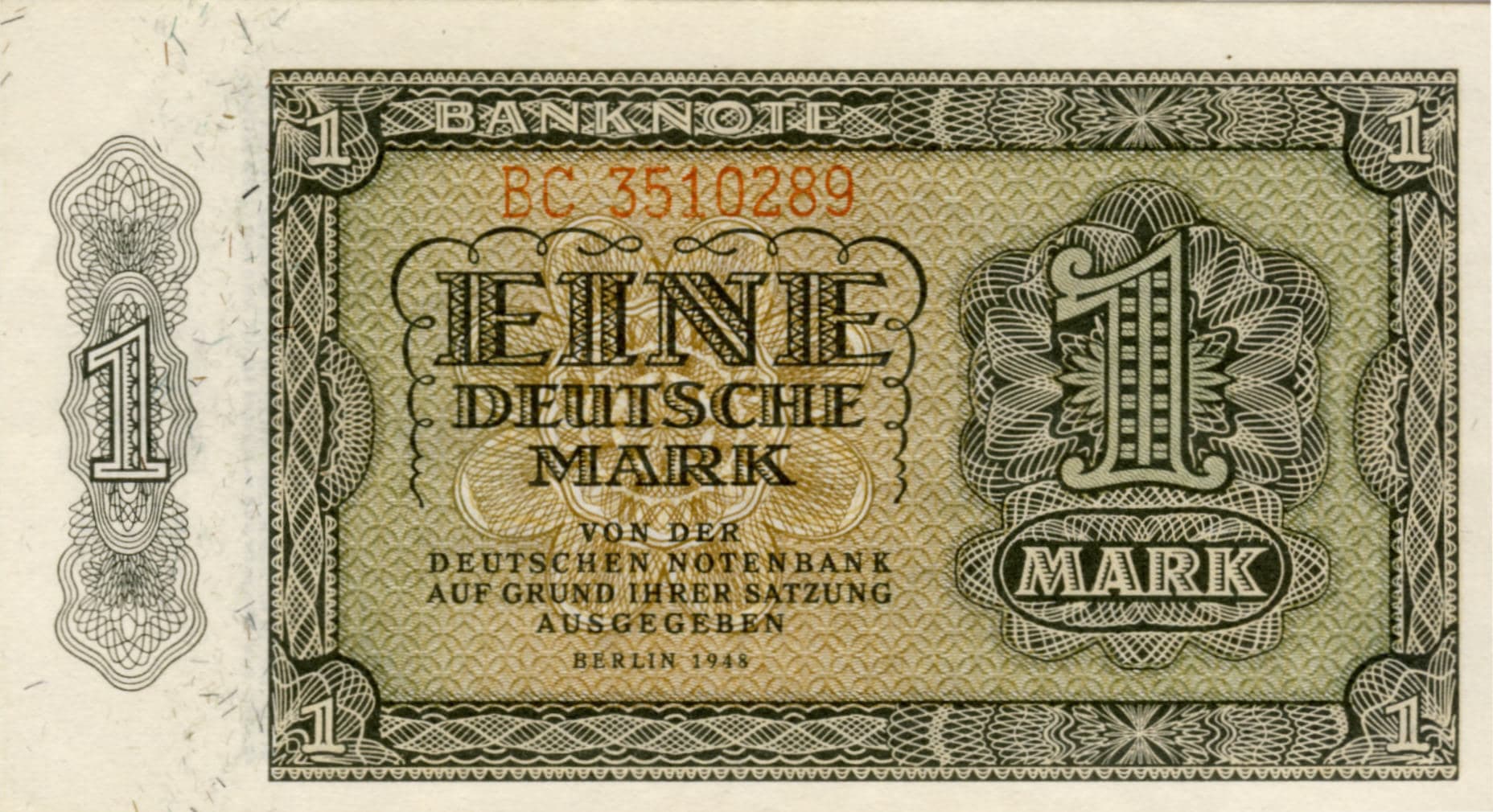
Every currency tells a story about the state that issued it. The East German mark, officially the Mark der Deutschen Demokratischen Republik and colloquially known in the West as the Ostmark, told a story that its issuers did not intend to tell. It was a currency that could not be used abroad, could not be exchanged at its official rate by anyone who understood economics, could not buy the goods its citizens most wanted, and could not survive contact with the open market.
By the time the Berlin Wall fell in November 1989, the fiction it embodied had become impossible to sustain, and the story of how that fiction was maintained, enforced, and eventually abandoned is one of the most revealing documents of life behind the Iron Curtain.
The Official Fiction: Parity with the West

From the moment the German Democratic Republic consolidated its monetary system in the late 1940s, the East German government insisted that its currency was worth exactly as much as the West German Deutsche Mark. One East Mark equaled one West Mark. The ratio was 1:1, and no official GDR document would suggest otherwise.
This was propaganda in the form of monetary policy. The Ostmark was a nonconvertible domestic currency: it could not be freely exchanged on international markets, it could not be taken out of the country, and it did not float. Its value was set by decree, not by supply and demand. The official parity with the Deutsche Mark had no relationship to what the two currencies could actually buy on the open market or what traders in West Berlin would pay for them.
Reality, as always, found a way to express itself. On the black market, through exchange offices in West Berlin, street transactions, and the informal economy that ran parallel to the official one throughout the GDR's existence, the true rate emerged. Five to ten East Marks for one West Mark was the going rate through most of the 1980s. By some accounts, by the final days of the GDR, the rate had slipped as far as 20:1 in practice. Currency exchange offices in West Berlin reportedly posted boards showing 1:20. The gap between the official exchange rate and the market rate was not a rounding error. It was the difference between a functioning currency and a fiction.
The Ostmark could not be spent abroad because no one outside the GDR had any reason to want it. East Germany's export profile, dominated by industrial goods and commodities traded within the Soviet bloc, did not generate international demand for its currency. The valuta the GDR desperately needed for international trade was hard currency: Deutsche Marks, US dollars, British pounds. Acquiring those currencies, in sufficient quantities to keep the planned economy functioning, became one of the central preoccupations of the East German state.
The Zwangsumtausch: Turning Visitors into a Revenue Stream

The GDR's solution to its chronic hard currency shortage was inventive in its coerciveness. Beginning in December 1964, the government introduced the Zwangsumtausch (the forced exchange, sometimes called the Mindestumtausch or minimum exchange), a requirement that most visitors from non-socialist countries exchange a fixed amount of their hard currency for East German marks upon entering the country, at the official rate of 1:1.
The starting rate in 1964 was modest: five Deutsche Marks per day for West Germans, three DM per day for West Berliners. Pensioners and children under 14 were exempted. But the principle was established: visiting the GDR was not free. Every Western visitor was, in effect, paying an admission fee to the state, disguised as a currency exchange.
The mechanics of this system revealed exactly how the East German government understood the value of its own currency. Exchanged at 1:1 while the market rate was anywhere between 1:5 and 1:20, each transaction was a direct transfer of real purchasing power from the visitor to the GDR treasury. The visitor received East Marks that could only be spent within the GDR, on GDR goods and services, at GDR prices. The state received Deutsche Marks: freely convertible, internationally accepted, and genuinely valuable. The profit margin on each transaction was enormous.
Over 26 years of operating the minimum exchange system, the GDR government extracted a total of approximately 4.5 billion Deutsche Marks from visitors in this way. The system was adjusted repeatedly as economic pressures fluctuated. By October 13, 1980, the daily minimum had risen to DM 25 per person per day, a considerable sum by GDR standards, where a monthly rent for a 40 square meter apartment could cost as little as 25 East Marks total.
The rules were modified to preserve what tourism the GDR wanted to attract. Tourists who booked hotel stays paid for in hard currency were exempted from the minimum exchange, on the logical basis that their hotel payments already funneled hard currency to the state and typically exceeded the DM 25 threshold anyway. West Berliners, who were demographically distinct and often visited on day trips, were sometimes given reduced requirements. Retirees and youth were granted exemptions or reduced rates at various points. The system was not rigid; it was calibrated to maximize hard currency extraction while not completely discouraging the flow of visitors who brought that currency in.
The unused East Marks presented their own problem for visitors. It was not possible to re-exchange them for Deutsche Marks upon leaving, as that would have defeated the entire purpose of the system. Day-trippers to East Berlin, who were required to exchange their DM 25 and then permitted only until midnight, often found themselves scrambling to spend a fairly substantial sum before the clock ran out. A visitor to the DDR Museum's account of the period captures the absurdity:
On my visits to East Berlin, I remember trolling through a book shop... where besides some guides to dog breeding and other equally obscure topics, the only books on offer were reasonably-priced, leather-bound copies of Lenin's Complete Works.
Records, museum visits, and food were the most common ways visitors burned through their forced exchange.
Military Exemptions and the Limits of GDR Sovereignty
One of the more unusual features of the exchange system was the blanket exemption granted to members of the Western Allied military forces stationed in West Berlin. American, British, and French military personnel entering East Berlin were not subject to the Zwangsumtausch at all.
This was not a diplomatic courtesy. It reflected a fundamental legal dispute about the status of East Berlin and the GDR's authority over it. The Western Allies had never formally recognized the GDR's claim to sovereignty over East Berlin; in their legal framework, the whole of Berlin remained under four-power authority from the end of World War II, with the Soviet Union holding authority over the eastern sector. The GDR could not regulate the activities of Western Allied military personnel in East Berlin because, in the Allied view, the GDR had no authority to do so. Only the Soviet Union, as the competent four-power authority, was recognized as able to impose conditions on Allied military movement.
This created an unusual practical situation. Western Allied military personnel could enter East Berlin without paying the admission fee that applied to every other Western visitor. They were also exempt from East German customs inspection. These two exemptions, taken together, made Allied military personnel uniquely positioned as black market participants, not by design but by the logic of the system. They could bring East German banknotes acquired in West Berlin at market rates (5 to 10 East Marks per Deutsche Mark) into East Berlin without having those marks confiscated at the border. The main purchasers of black market East German banknotes in West Berlin, according to multiple historical accounts, were Allied military personnel taking advantage of precisely this combination of exemptions.
Intershop: Hard Currency as a Parallel Economy
If the Zwangsumtausch was the GDR's mechanism for extracting hard currency from foreign visitors, the Intershop network was its mechanism for extracting hard currency from its own citizens, and in doing so it created one of the most visible and socially corrosive contradictions in the GDR's self-image as an egalitarian socialist state.
Intershop was a state-run retail chain founded on December 14, 1962, initially targeting Western visitors and transit travelers at airports, railway stations, border crossings, and Autobahn rest stops. The premise was simple: Intershops would sell Western and high-quality imported goods, but only for hard currencies: Deutsche Marks, US dollars, British pounds. The East German mark was not accepted. In 1962, annual sales at the first locations already exceeded one million Deutsche Marks. The concept expanded rapidly. By the mid-1970s, more than 270 Intershop locations were operating across the GDR. By the end of the decade, annual revenues were estimated at $250 million.
The product range expanded with the network. By the 1980s, Intershops stocked food, alcohol, tobacco, electronics, clothing, cosmetics, toys, watches, musical recordings, and even Western automobiles including Volkswagen and Volvo. These were things simply unavailable in ordinary GDR state shops, or available only after years-long waiting lists, as was the case with the domestically-produced Trabant car.
Until 1974, East German citizens were legally prohibited from possessing hard currency. The Intershop network was, in theory, exclusively for foreigners. In practice, East Germans who had received currency gifts from Western relatives used these stores regardless. The government, recognizing both the practical impossibility of enforcement and the revenue opportunity, legalized possession of hard currency for GDR citizens in 1974, formally extending Intershop access to its own population.
The social consequences were immediate and lasting. Intershops created a visible, legally sanctioned inequality between East Germans who had access to Western currency, primarily through family ties to the West, and those who did not. The people who could shop at Intershops had jeans, Western cigarettes, quality electronics. The people who could not had the limited offerings of state retail. Erich Honecker himself acknowledged the ideological tension in a 1977 speech on GDR state television, calling the shops "not a constant companion of socialism" while defending them as a pragmatic necessity given the 9.5 million Western visitors entering the country annually.
The Stasi, predictably, monitored Intershops closely. Cashiers were frequently relatives of Stasi agents. Security cameras were installed in some locations. The tracking of hard currency and who had access to it was a priority of the security apparatus. When the GDR introduced Forum checks in April 1979, a non-refundable and non-transferable voucher issued in exchange for hard currency at the state bank, the stated purpose was to streamline Intershop transactions, but the equally important purpose was surveillance. Forum checks allowed authorities to track exactly how much Western currency each citizen had and where they spent it.
The Black Market and the Reality Behind the Numbers
The gap between the official 1:1 parity and the market rate of 5:1, 10:1, or beyond was not merely an abstraction. It was a daily lived experience for anyone navigating the dual currency system of the GDR.
In West Berlin's exchange offices during the mid-1980s, East German banknotes in denominations of 50 and 100 marks were openly sold at rates of 5 East Marks to 1 Deutsche Mark. This was technically illegal, as the export of Ostmarks from the GDR was prohibited, but enforcement was arbitrary and often simply required handing over the marks at the border rather than any more serious penalty.
For Western visitors who acquired East Marks at black market rates before entering, the arbitrage opportunity was real. DM 10 purchased 50 or 100 East Marks in West Berlin; those same marks, once inside the GDR, could be spent on goods and services priced at East German levels. A restaurant meal, a museum admission, a live concert, a night at a non-hard-currency hotel: all could be had at rates that were, by Western standards, extraordinarily cheap, as long as you had entered with black market marks. The risk of being caught with currency obtained through unofficial channels was real but inconsistently applied.
For East German citizens, the situation was reversed. The Ostmark they earned through wages was adequate for the planned economy's subsidized basics like the cheap bread roll and the low rent, but useless for the consumer goods they actually wanted. Western currency was the only gateway to those goods, and the only legitimate sources of Western currency were gifts from relatives in the Federal Republic or the rare opportunity to work abroad. Neither was available to most people.
The Begrüßungsgeld: West Germany's Counter-move
The asymmetry of the exchange system had a mirror image on the Western side. From 1970, the government of West Germany operated the Begrüßungsgeld ("welcome money"), a per capita cash payment to visitors from the East. Originally DM 30, payable twice a year and initially aimed at supporting elderly East German visitors who had little access to hard currency, the program was expanded and eventually raised to DM 100 per year by 1988.
The contrast was stark. East Germany was extracting a minimum of DM 25 per day from every Western visitor in a compulsory exchange at an artificial rate. West Germany was giving DM 100 per year to every Eastern visitor as a gift. The ideological messaging was not accidental.
When the Berlin Wall fell in November 1989 and the borders opened, the Begrüßungsgeld system was overwhelmed. Within days, the paying offices in West Berlin and West Germany were surrounded by queues of tens of thousands of people. By November 22, 1989, just two weeks after the Wall opened, almost 11 million GDR citizens had visited the Federal Republic or West Berlin. In November and December 1989 alone, approximately four billion Deutsche Marks were paid out in welcome money. The program was suspended on December 29, 1989, as reunification became inevitable.
The End: Monetary Union and the Ostmark's Demise
On July 1, 1990, three months before formal political reunification on October 3, the Deutsche Mark became the official currency of East Germany. The Zwangsumtausch had already been suspended in December 1989 by GDR Finance Minister Uta Nickel, recognizing that the logic of the forced exchange had dissolved along with the border it depended on.
The terms of monetary union were politically charged. The West German Bundesbank argued for a 2:1 conversion rate, which would have more accurately reflected the Ostmark's market value. The GDR's own state bank argued for rates that would protect the purchasing power of citizens' savings. Chancellor Helmut Kohl, facing the political reality that hundreds of thousands of East Germans were still emigrating monthly, with chants of "If the Deutschmark comes, we'll stay, if it doesn't, we'll go to it," opted for a largely 1:1 conversion. Wages, salaries, pensions, and savings up to DM 2,000 per adult (DM 1,000 per child) were converted at parity. Larger savings converted at 2:1.
The decision was explicitly political. It was also, as economists immediately recognized, an enormous gift that carried enormous costs. East German industrial output collapsed almost overnight when exposed to market competition at a wildly overvalued currency. By some estimates, real GDP in East Germany fell 25% in the 18 months after the monetary union. Employment in manufacturing crashed. Thousands of enterprises went bankrupt. What had been hidden by four decades of planned economy pricing, namely the fundamental uncompetitiveness of much of the GDR's industrial base, was suddenly and brutally visible.
The physical Ostmark followed its economic irrelevance into disposal. Around 4,500 tonnes of coins were melted down at the Rackwitz metal works in 1990. The paper money, approximately 100 billion marks in 620 million banknotes filling roughly 300 boxcar equivalents, was transported by military convoy to two sandstone caverns in the Thekenberge near Halberstadt, where it sat in storage until 2002. It was then incinerated, ending a currency that had always been worth less than it claimed.
What remained was not money but memory: the aluminum coins light enough to float on water, the leather-bound Lenin, the Intershop with its Western cigarettes, the exchange office window in West Berlin offering 1:10 for a currency the GDR government insisted was worth exactly the same as the mark in your pocket.
References
- Britannica. (n.d.). Introduction of the Deutsche Mark in East Germany. https://www.britannica.com/video/180290/deutsche-mark-East-Germany-currency-reunification-step-1990
- Currency History Hub. (2025, November 12). The East German Mark (Mark der DDR): Currency in a planned economy. https://currencyhistoryhub.com/east-german-mark-planned-economy/
- DDR Museum. (2016). Minimum exchange and welcome money in the GDR. https://www.ddr-museum.de/en/blog/2016/minimum-exchange-and-welcome-money-in-the-gdr
- DDR Museum. (2016). Shops and department stores in the DDR: The Intershop retail chain. https://www.ddr-museum.de/en/blog/2016/shops-and-department-stores-ddr-intershop
- DDR Museum. (2025). Western money at last! The monetary union of 1 July 1990. https://www.ddr-museum.de/en/blog/2025/western-money-at-last-the-monetary-union-of-1-july-1990
- GDR Objectified. (2013, February 8). Strange currencies: Money in the GDR. https://gdrobjectified.wordpress.com/2013/02/08/strange-currencies-money-in-the-gdr/
- Tontine Coffee-House. (2019, April 15). Eastern Bloc hard currency shops. https://tontinecoffeehouse.com/2019/04/15/eastern-bloc-hard-currency-shops/
- Wall Museum Berlin. (2023). Intershops in the GDR. https://thewallmuseum.com/en/19-december-1973